Friday, February 23, 2007


Privacy Concerns a Key Hurdle for Locaton Based Services

Most mobile phone users in the U.S. worry about privacy when it comes to next-generation telecommunications technologies a recent survey found. Harris Interactive polled 1,028 adults in the U.S. to determine public attitudes on location-based services (LBS). LBS uses GPS-enabled cell phones to target custom advertising and services to the user.
Harris found that about 1 in 4 mobile phone owners would like to be able to find out the availability of their contacts (available, busy on a call, unavailable). 18% would be very interested in the ability to determine the current location of persons on their contact list and 14% would like to be able to find out where their contacts had been recently. However, when those same respondents were asked how they would feel about other people having the same information about them, the majority said that such services would be an invasion of their privacy.
When asked how they would feel about people knowing their location, most people wanted to keep that in the family:
- 58% said that they would want their spouse to know where they were.
- 46% were okay with their children having access to the same information.
- 6% would want their co-workers to know where they were and
- 5% would want their employers to have access to their location
While often touted as the next big thing, LBS hasn't caught fire yet, Only 4% of those surveyed said that they would switch wireless carriers to have LBS features. Joe Porus a VP at Harris Interactive says that LBS will eventually catch on, "But providers must give users control over location-based features to allay privacy concerns." Not surprisingly, among the first groups expected to embrace LBS technology: teenagers.
The complete report is here.See also: Location Technology One Of The Fastest Growing Sectors Of GPS Technology.
location based services
Vodafone and Google are planning to develop a location-based version of Google Maps for mobile to add to the growing portfolio of internet-based services offered by the mobile operator.
Google Maps for mobile, a downloadable java application, is expected to offer customers in selected markets easy-to-use maps and local listings, as well as local search and navigation capabilities. Customers will be able to have unlimited use of Google Maps for mobile, subject to Vodafone data tariffs.
Google and Vodafone are working together to ensure the service provides customers on selected handsets with an automatic user-location capability.
The announcement comes as Vodafone introduces functionality in various markets to enable its customers to search for and find information they are looking for while on the move, with the integration of Google search technology into its mobile service.
The search service launched in Hungary in December 2006 and is aimed to be rolled out in other key European markets throughout the rest of the year.
Forming part of Vodafone's multimedia portal Vodafone live!, search technology from Google will enable customers to access both on-portal and off-portal sites in the mobile internet.
The integration of Google technology also means an enhanced internet experience, making off-portal pages more accessible and relevant for handset screen sizes. Customers will therefore only be presented with services, such as games, that are compatible with their handsets.
location based services
Opera Software have announced plans to upgrade its mobile web browsing software by developing Opera 9 for mobile phones in all major platforms.
The company says it will incorporate the latest in PC browsing features such as Widgets and Intelligent Zoom to its upcoming Opera Mobile edition.
Opera 9 on mobile phones promises to add a new dimension to web navigation. Users will be able to seamlessly alternate between viewing modes to get a birds-eye perspective or dive into the content they want. Users have the choice to see an overview of a Web page or adapting the page to the width of the screen. As first seen with the Opera browser for Wii, Intelligent Zoom allows users to then zoom in directly to a selected area.
Widgets are small Web applications running outside of the browser and allowing users, manufacturers and operators to create and personalize services derived from Web content such as weather and traffic information, news and e-mail. Widgets offer Web applications that are instantly accessible on the phone without having to launch the Web browser, presenting dynamic and engaging content directly to users.
Opera's JavaScript and rendering engines are built for speed while enabling dynamic AJAX-based applications. Driving standards compliance, Opera Mobile has full DOM support and can smoothly run advanced Web applications on mobile phones.
 Opera Software have announced plans to upgrade its mobile web browsing software by
location based services
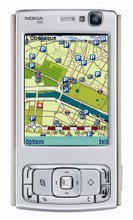
Nokia has introoduced the new Nokia 6110 Navigator, a navigation-enabled mobile phone designed for the mass market, bringing together GPS (Global Positioning System) and AGPS (Assisted Global Positioning System) functionality with always-on mobile connectivity.
The Nokia 6110 Navigator features full personal navigation experience with integrated maps, routing and navigation. With the Nokia 6110 Navigator, users can quickly view their current location on the map, search for destinations, find specific routes, or locate services such as restaurants, hotels or shops that are nearby.
Featuring full turn-by-turn 3D navigation, the Nokia 6110 Navigator suggests the best route to follow to reach a location by car or on foot. Clear instructions by voice guidance and turn arrows on a map ensure finding the fastest way to the destination.
The Nokia 6110 Navigator comes with a local map pre-installed on the memory card ready for immediate navigation. Additional maps and content - such as traffic information, weather services and travel guides - can be purchased online. Additional maps can be transferred to the phone by using the Nokia Map Manager application included.
The maps also show thousands of points of interest, such as restaurants, hotels, shops or other services nearby the location, including phone numbers and web addresses for calling and browsing directly with the phone. And, because the map's information is located in the mobile phone, it can be shared with family or friends with the touch of a button.
The device connects to HSDPA (High Speed Downlink Packet Access) networks with speeds up to 3.6 Mbps. It also supports WCDMA 2100 HSDPA and GSM/GPRS/EDGE quad-band (850/900/1800/1900 MHz). Emails can be handled in real time by push email, which also supports attachments as well as features a Message reader function to read aloud your emails.
The Nokia 6110 Navigator is expected to begin shipping in the second quarter of 2007.
 Nokia has introoduced the new Nokia
location based services
Palm, Inc. has announced the Palm Treo 750 in Australia, the first Treo device to take advantage of Telstra's Next G network. The Treo 750 runs on Microsoft's Windows Mobile 5.0 and includes High-Speed Downlink Packet Access (HSDPA) capability for high speed cellular data access.
The Treo 750 (pictured in the Cingular version) combines a multifeatured mobile phone with email, messaging, web browsing and organisation software all in a new compact design. The new handset comes with Microsoft's Messaging and Security Feature Pack (MSFP) for Windows Mobile 5.0, which includes Direct Push Technology and enhanced security features free and out of the box, when connected to a Microsoft Exchange Server 2003 SP2.
The Treo smartphone on Windows Mobile 5.0 provides mobile workers with productivity and multimedia experiences while away from their PCs. It provides people with fast access to information, ease of use and simplicity on their mobile device, including Today Screen enhancements, which offer the ability to "dial by name" with a few keystrokes on the keyboard, perform a web search directly from the Today Screen and perform one-touch dialling with personalized photo speed dials; ability to manage a call directly from the Today Screen and stay on top of voicemail with on-screen, VCR-like icons, such as rewind, delete and fast-forward controls for easy navigation;
Users also have the ability to ignore a call and quickly compose a text message, such as "In a meeting" or "Can't talk"; and a dedicated messaging application for SMS/MMS that is organized in a "chat thread" so users can reference prior messages and use emoticons for a personal touch.
 Palm, Inc. has announced the Palm Treo 750 in Australia, the first Treo device to take advantage of Telstra's Next G network. The Treo 750 runs on Microsoft's Windows Mobile 5.0 and includes High-Speed Downlink Packet
President Bush on Thursday extolled the science of turning grasses and wood chips into ethanol to lessen the U.S. thirst for foreign oil.
'If you really want to reduce the amount of oil that you consume, you have to reduce the amount of gasoline you use,' Bush said on a road trip to push energy initiatives he announced last month in his State of the Union address.
Bush has proposed ramping up the production of alternative fuels such as ethanol made from something other than corn. The president wants to require the use of 35 billion gallons a year of ethanol and other alternative fuels, such as soybean-based biodiesel, by 2017 — a fivefold increase over current requirements.
The call for sharp increases in ethanol use will get bipartisan support in Congress. But production of ethanol from corn is expected to fall far short of meeting such an increase. So Bush envisions a major speedup of research into production of 'cellulosic' ethanol made from wood chips, switchgrass and other feedstocks.
Each year, the United States consumes about 7 billion gallons of ethanol, made primarily from corn. The demand for corn for agricultural uses as well as energy, however, is causing corn prices to rise.
'The problem is"
Thursday, February 22, 2007
Location Signature for All News Reports with Universal Address Enhanced Google Maps
location based services
things are really starting to cook in the mashup space
when Rupert Murdoch gets onboard I guess locational info has gone mainstream
Location Signature for All News Reports with Universal Address Enhanced Google Maps
location based services
things are really starting to cook in the mashup space
when Rupert Murdoch gets onboard I guess locational info has gone mainstream
location based services
The Blackberry, or smart phone, which combines a cell phone with Internet access, and other handheld gadgets have revolutionized the way business people work. But these devices can be so addictive that they are having an adverse effect on families. For producer Saba Shah Khan, VOA's Jim Bertel tells us how this technology craze is changing family dynamics. Blackberries are used to send e-mails wirelessly

Sushil Bansal, a father of two, runs a company in Washington, DC. Thanks to technology, he can take care of much of his business while spending time with his daughters Antara and Saranga. The broadband service on his smart phone keeps him connected with his office and that is how he is able to manage most of his work with the help of his laptop. "These gadgets help me stay connected with my business even though I am outside the office," he told us.
 |
| Sushil Bansal says the gadgets help him in juggling his work and family time |
Her reaction is not unusual. A study by Rutgers University in the eastern state of New Jersey finds that as technology makes work more accessible, the Blackberry and other gadgets are fueling a rise in e-mail and Internet addiction that is in some cases as difficult to kick as a drug habit.
Roger Rubin, Professor of Family Studies at the University of Maryland, says excessive use of these devices can negatively affect your family life. "The price that children pay, essentially, is emotional neglect and sometimes even physical neglect because nobody is there to embrace you, to wipe away your tears when you are crying because they are busy on a computer, they are busy with their Blackberry, [or] they are busy and totally consumed with their career or work."
Jeff Buhl and Heather Acord both like to stay on top of technology and say their Blackberries are essential. Buhl admits that he has been caught e-mailing at inappropriate times. "I am sure you have been at a family function when it stopped being fun, so that might be the time to check your e-mail or respond to that message that you got yesterday. Yes, I'll do that."
Rubin says that using your Blackberry at the dinner table, during vacations and when spending time with children are alarming signs. Like any addiction, experts believe the user has a choice: access to the office 24 hours a day, or spending quality time with your family.
location based services
Cisco Systems Inc. and Apple Inc. agreed to share the iPhone brand, dismissing Cisco's lawsuit for trademark infringement.
The agreement allows both companies to use the iPhone name and calls for their products to work together in the future, the companies said last night in a joint statement.
The settlement ends a six-week dispute between the Silicon Valley firms and puts Apple, of Cupertino, Calif., on schedule to start selling its combination iPod music player and mobile phone under the iPhone brand in June.
"IPhone is worth a hell of a lot more to Apple than to Cisco," John Daniel, a partner at Kramer Levin Naftalis & Frankel L.L.P., of New York, said before the announcement. He is not involved in this case. "The 'I' prefix is what Apple has been developing, and if it didn't have that, it would be unhappy. I don't think anybody associates iPhone with Cisco these days."
Cisco, of San Jose, Calif., the world's largest maker of computer-networking equipment, claimed last month that Apple's iPhone violated a trademark Cisco has owned since 2000. Apple, which unveiled the device Jan. 9 in San Francisco, called the suit "silly" because its iPhone differs from Cisco's Internet-based home phone.
Shares of Apple finished $3.30 higher at $89.20 yesterday in Nasdaq Stock Market composite trading, and have jumped 29 percent in the last year. Cisco shares fell 28 cents, to $27.38, and are up 40 percent in the last 12 months.
Apple approached Cisco about using the name several times during the last year and announced the product before an agreement was reached, according to a Jan. 10 blog posting by Cisco general counsel Mark Chandler.
Apple still faces possible delays in Canada, where closely held Comwave Telecom Inc. has used the iPhone brand since 2004 to sell Web-based phone service. Comwave said in January that it filed documents opposing Apple's motion to take the name.
Cisco "wants to ride Apple's brand recognition and get a little coattail effect," James M. McCarthy, a partner at McDonnell Boehnen Hulbert & Berghoff L.L.P., of Chicago, said before the announcement. He is not involved in the case. "Interoperability was important to Cisco."
Apple chief executive officer Steve Jobs said last month that he expected to sell 10 million iPhones, which cost as much as $599 apiece, in 2008. The move puts Apple in competition with Research in Motion Ltd.'s BlackBerry and Palm Inc.'s Treo.
Cisco's iPhone is part of its Linksys home routing unit, which the company purchased in 2003 to tap the consumer market. The phones, which sell for less than $100, enable Web-based calls through eBay Inc.'s Skype service and Yahoo! Inc.'s Messenger.
Wednesday, February 21, 2007
Leveraging our PDA engineering experience, we developed and released the world's first GPS-integrated PDA back in 2003. The success of this breakthrough product in highly competitive markets such as Taiwan and South Korea quickly established Mio Technology as one of the fastest-growing GPS navigation companies in the world. The Mio DigiWalker brand was launched in Europe in 2004, soon followed by expansion to Australia, Japan and the United States. Supported by easy-to-use software and integrated hardware functionality, we quickly captured market share in these new segments.
Today, Mio Technology is an industry-leading company with operations in Taiwan, China, Japan, South Korea, Australia, United States, and Europe. Mio's product range includes personal navigation devices (PND), personal digital assistants (PDAs) and smartphones. We employs 2000 individuals worldwide, including over 1200 R&D staff, all dedicated to bringing the latest technologies for the mobile digital lifestyle to market."
Monday, February 12, 2007
location based services
3GSM Barcelona, 12-15 February 2007: m-spatial, the market leader in mobile local search, today announces the launch of its solution for Converged Local Search- a major new initiative designed to stimulate mass market consumer adoption of local search on mobile devices. Converged Local Search enables Mobile Network Operators, Directory Providers and Personal Navigation Providers to realise the huge potential of local search by seamlessly linking access to local information across web-sites, 118/411 directory services, mobile data services and personal navigation devices.Converged Local Search benefits Personal Navigation Providers and 118/411 Providers by providing their 'on the move' consumer customers with access to the additional rich and dynamic local information delivered by m-spatial's market leading mobile local search capabilities as an extension to existing services. For example, users of a personal navigation system integrated with Converged Local Search can not only find their way to a nearby cinema, but can also find out what's on and book a ticket. This provides competitive advantage in an increasingly commoditised market, in addition to offering access to a new revenue stream.Mobile Network Operators and Directory Providers benefit from significantly increased usage of their existing mobile local search services through the integration of high volume web-site interactions with local information via a 'send to mobile' mechanism. This allows users to investigate and identify businesses and amenities that may meet their needs on web-sites and then 'download' the identity of the business/amenity to their mobile phone for later access whilst 'on the move'."All major mobile studies highlight consumer interest in access to locally relevant content and services, but the industry has historically been poor at translating this demand into real usage and revenues," said Andy Walker, CEO of m-spatial. "We believe that by seamlessly linking access to local information via web-sites and 118/411 services with 'on the move' access via mobile phones and personal navigation devices, we can begin to make Converged Local Search part of consumers' everyday lives, a significant step in achieving mass market adoption. Couple this with the major attraction to local advertisers of reaching 'on the move' consumers who are close to their businesses and have an imminent intention to purchase, and Converged Local Search is set to provide a major new revenue stream"Converged Local Search will be delivered to Mobile Network Operators, Directory Providers and Personal Navigation Providers via m-spatial's market leading Local Search and Discovery Engine (LSDE) product. m-spatial will be demonstrating this new capability during 3GSM Congress in Barcelona at stand 1E57.About m-spatialBased in Cambridge, UK, m-spatial is the market leader in converged local search - connecting consumers to 'local' businesses and information via mobile phones and personal navigation devices. m-spatial provides its products via a white label ASP delivery model to mobile network operators, directory providers and personal navigation providers. Its international customers include Orange, Vodafone, O2 and Seat PagineGialle, Italy's leading directory provider. m-spatial's innovative and unique approach to mobile local search delivers a 'made for mobile' user experience which offers consumers quick and simple access to both a breadth and depth of 'local' information including businesses, amenities, events and traffic conditions and is compatible with the majority of mobile devices. Converged local search also offers 'on the move' access to the same information for businesses and amenities identified via local information channels such as third party web-sites and 118/411 directory services.www.m-spatial.com
location based services
BARCELONA, Spain, Feb. 12 -- QUALCOMM Incorporated (Nasdaq: QCOM), a leading developer and innovator of advanced wireless technologies and data solutions, today announced that the Company will showcase a wide range of innovative wireless solutions at the 3GSM World Congress 2007 (Booth B53, Hall 8) in Barcelona, Spain, Feb. 12-15, including HSPA and UMTS chipsets, Multimedia Broadcast Multicast Service (MBMS) mobile TV technology, the latest BREW(R) offerings and applications, location-based services and live demonstrations of the MediaFLO(TM) System."QUALCOMM is committed to helping the global wireless industry continue its rapid evolution, as well as achieve its primary goal of ensuring mobile phones and wireless services are accessible and affordable to people in both the developed and developing markets," said William F. Davidson Jr., vice president, global marketing and investor relations for QUALCOMM. "We're proud to be a part of 3GSM 2007 and, along with our partners, showcase our advanced wireless solutions."QUALCOMM will host a press and analyst briefing in the Zafir room of the Hotel Fira Palace on Monday, Feb. 12, from 4-5 p.m. Company executives will discuss QUALCOMM's latest news announcements.During 3GSM 2007, QUALCOMM and its partners will be conducting a number of live demonstrations:
MediaFLO Technologies demonstration of 20 live-streaming television channels, including Spanish and European content from Abertis and Sky, and Clipcasting(TM) content from Warner Music Group on three OEM handsets
IP datacasting demonstrations of news, sports and weather streaming
The world's first demonstration of MBMS mobile TV technology, delivering multiple channels over the air using UMTS networks
Mobile Station Modem(TM) (MSM(TM)) MSM7XXX-series chipsets, showcasing stunning 3D graphics and gaming capabilities
Position-location capabilities of gpsOne(R) assisted-GPS technology and gpsOneXTRA assistance technology, which expands the capabilities of standalone GPS
High-quality VoIP demonstration using HSPA technology, and running simultaneously with other leading data applications such as video sharing, video streaming and Web browsing
HSPA video streaming, Web browsing and video sharing
Commercial uiOne(TM) handsets and demonstrations of advanced uiOne capabilities
BREW gaming and BREW locate signature solutions
Dell, HP and Lenovo will demonstrate their latest HSDPA-embedded notebook computers in QUALCOMM's booth, all on the commercial Vodafone Spain HSDPA network
OQO Inc., in collaboration with Novatel Wireless, will conduct a technology demonstration of their Ultra Mobile PC (OQO model 02) with HSPA capability, incorporating the MSM6280(TM) chipset targeted for Europe and AsiaQUALCOMM executives also will discuss key wireless industry trends at 3GSM:
Kamil Grajski, vice president of engineering for QUALCOMM and president of the FLO Forum, will participate in the FLO Forum press roundtable on Tuesday, Feb 13, 2-3 p.m. in the Media Center, Hall 2. He will also participate on a panel entitled, "Technology Symposium - Are standards and their development failing the industry?" on Wednesday, Feb. 14, 11:15 a.m.-12:40 p.m. on the ground floor of Hall 5.
Enrico Salvatori, vice president and general manager of QUALCOMM CDMA Technologies Europe, will participate in a panel entitled, "Technology Symposium - HSPA: Rollout & Realities," on Wednesday, Feb. 14, 4:50- 6:20 p.m. on level 3 of Hall 5.
Omar Javaid, vice president of business development for MediaFLO Technologies, will participate in a panel entitled, "Mobile TV - Can it Deliver?" on Thursday, Feb. 15, 2-3:20 p.m. in Hall 5.QUALCOMM Incorporated (www.qualcomm.com) is a leader in developing and delivering innovative digital wireless communications products and services based on CDMA and other advanced technologies. Headquartered in San Diego, Calif., QUALCOMM is included in the S&P 500 Index and is a 2006 FORTUNE 500(R) company traded on The Nasdaq Stock Market(R) under the ticker symbol QCOM.
location based services
Barcelona, February 12th 2007 – 24access, a provider of solutions that enable a two way connection between a PC and a mobile device, today announced the launch of Mobile Media Center. Mobile Media Center is a totally new product that for the first time allows consumers to access all the content stored on their PC through their mobile phone. MMC is available immediately for consumers to download for free from www.24access.com. Mobile Media Center has been designed and created to allow consumers the opportunity to access content from any mobile handset through any provider. Now saved content such as photos, music and films can be viewed, listened to and watched using a mobile phone.Streaming content can also be accessed directly through mobile phones by using Mobile Media Center. Consumers can access webcams, live radio and television on their mobile phone via their PC.Not only is personal access of content available, users can also benefit from the unique sharing functionality and share the content with friends and family.“For the first time people have the ability to regain control over when, how and where they enjoy their own content,” said Arjan Dost, CEO of 24access. “Consumers no longer have to be content with the walled garden approach to content that is taken by many of the major operators. Files that have been accessed and downloaded using a broadband connection at home are now instantly available to the consumers’ mobile phone.”Mobile Media Center offers an additional channel to market for content publishers and allows them to potentially increase advertising revenues. Consumers that are not in front of their PC can now be targeted by compelling content as they can now access it through their mobile phone.
location based services
Oslo, Norway and Barcelona, Spain - February 12, 2007 - Opera Software today announced plans to upgrade mobile Web browsing by developing Opera 9 for mobile phones in all major platforms. Opera 9 has enriched Web use on the PC with new technologies, and now the leading browser innovator will deliver the same groundbreaking functionality to mobile phones. The upcoming Opera Mobile edition includes the latest in PC browsing features such as Widgets and Intelligent Zoom.Opera 9 on mobile phones will add completely new dimensions to navigation. Users can seamlessly alternate between viewing modes to get a birds-eye perspective or dive into the content they want. Users have the choice to see an overview of a Web page or adapting the page to the width of the screen. As first seen with the Opera browser for Wii, Intelligent Zoom allows users to then zoom in directly to a selected area.Widgets will also debut on mobile phones with the upcoming release of Opera Mobile. These small Web applications running outside of the browser allow users, manufacturers and operators to create and personalize services derived from Web content such as weather and traffic information, news and e-mail. Widgets offer Web applications that are instantly accessible on the phone without having to launch the Web browser, presenting dynamic and engaging content directly to users."We are impressed with the constantly evolving experience of browsing the Web," says Jon von Tetzchner, CEO, Opera Software. "Bringing Opera 9 to mobile phones will present new capabilities in mobile Web services that will be exciting to see defined."Opera's JavaScript and rendering engines are built for speed while enabling dynamic AJAX-based applications. Driving standards compliance, Opera Mobile has full DOM support and can smoothly run advanced Web applications on mobile phones.Opera Mobile is currently shipped on more than 50 million phones from major manufacturers such as Motorola, Nokia, Samsung and Sony Ericsson. For more information, visit http://www.opera.com/products/mobile/.Opera Mobile Features to include...
Intelligent Zoom: Zoom in directly to a selected area and continue scrolling for a closer view.
Grab and scroll: Touch and direct the page up or down on touch-screen devices.
Multiple Windows/Tabbed browsing: Use multiple windows for multi-task browsing.
Opera Widgets: Small Web applications that users can easily access without having to open the Web browser.
Web-address input auto-completion: Reduce input time with an index of address completions.
Password manager: The password manager remembers your usernames and passwords so you don't have to.
Download manager: View download progress and access all your downloads from one simple transfer manager window.
Pop-up blocker: Control whether to block all pop-ups, or open only the ones that you have requested.
Bookmarks and History: Keep quick access to your favorites and get back to your last viewed sites.
Send link as e-mail, SMS, MMS: Send links to e-mail or as messages directly from the browser. About Opera Software ASAOpera Software ASA has redefined Web browsing for PCs, mobile phones and other networked devices. Opera's cross- platform Web browser technology is renowned for its small size, performance and standards-compliance, while giving users a faster, safer and more dynamic online experience. Opera Software is headquartered in Oslo, Norway, with offices around the world. The company is listed on the Oslo Stock Exchange under the ticker symbol OPERA. Learn more about Opera at www.opera.com.
location based services
A new look for Google Maps Australia
Asher MosesFebruary 6, 2007
Google today unveiled Google Maps Australia, an online mapping service providing Australian business listings and driving directions that are accessible from a PC or mobile phone.
Until now, the website simply provided flat street maps and satellite images, but the upgrade today means it now offers virtually identical functionality to its US counterpart.
For example, entering a keyword such as "electrician", followed by a suburb, returns a list of nearby electricians.
Alternatively, users can search for specific businesses, and their locations are then displayed on a map that can be overlayed with driving directions from any given point.
Carl Sjogreen, a senior product manager at Google, said that, in addition to basic contact information and street addresses, the business listings also included "richer information that we get from the web", such as hours of operations, the types of payment the business accepts and even whether or not there is a wireless hotspot on the premises.
All of the information can be accessed from either a PC or a mobile phone, provided the latter is equipped with the free Google Maps Mobile application.
Google is providing the service at no cost to either businesses or users, but business owners looking to add or modify their own listings must first verify themselves with Google.
"We send a postcard to the business address with a little number on it and you just type that number in on our website," said Mr Sjogreen when describing the verification process.
He added that, even though the service was free, Google planned to earn revenue from it by including "sponsored links" next to search results, as it does with its regular search engine.
But Google's expansion of its online mapping service into Australia appears to be belated, as Microsoft has offered similar functionality through its Live Local website for about a year, according to Microsoft Australia online services manager Harvey Sanchez.
Google will also compete with the online version of the Yellow Pages run by Testra's Sensis arm, which offers business listings and driving directions using maps provided by sister service WhereIs.com.
Thursday, February 01, 2007
location based services
Although Europe is lagging in its uptake of GPS in mobile phones behind the US (where it was mandated) and Japan (where they just like new technology) it’s beginning to catch up, according to the BBC. The article goes through the sort of services GPS will enable, and mentions that the Gallileo system (Europe’s equivalent of GPS) is behind schedule and so the industry can’t develop for it. It quotes research firm Canalys as saying that in 2006 there were nearly 12 million GPS devices sold around the world, and it expects that to increase to 28 million next year, with Europe increasing its uptake of the technology.